


Blog

2025 Year-End Tax Checklist

Only 31 days until 2026! By taking certain steps before the end of the year, you might be able to significantly reduce your 2025 tax bill. This month, we’ll go over some things to review before the end of the year.

Review Major Life-Event Taxes

If any of these happened in 2025, adjust your tax planning as they can change your deductions, tax bracket and filing status.

• Marriage or divorce

• Birth or adoption

• Home purchase or sale

• Large medical bills

• Inheritance

• Starting or closing a business

Review Your Withholding & Estimated Taxes

Do you hate having to pay penalties for not having adequate withholding or quarterly payments? You can avoid these via the IRS “Safe harbor rules.” These rules protect taxpayers from underpayment penalties as long as they meet certain minimum payment requirements — even if they end up owing more tax when they file. These are most commonly used for estimated tax payments. Here’s how it works: pay at least 90% of the tax you owe for 2025 or pay 100% of your 2024 tax (110% if your income was over $150,000) to avoid any penalties.

Decide Whether to Itemize or Take the Standard Deduction

For 2025, the standard deduction for single filers is $15,750 and for joint filers it’s $31,500. So, now you need to tally up your eligible itemized deductions to see which approach is best for you.

As a reminder, itemized deductions can include:

• Medical expenses that are over 7.5% of AGI. So, if possible, schedule elective procedures or pay medical bills before year-end if it helps surpass the 7.5% of AGI threshold.

• State and local taxes up to $40,000 in 2025 (deduction is reduced or even eliminated for high-income filers).

• Mortgage interest on qualified loans. Interest on your mortgage, points and prepaid interest and Home Equity Loans and Lines of Credit (HELOCs) used to buy, build or substantially improve your home are deductible.

• Charitable contributions. You can donate cash or appreciated investments. If you’re 70½+, you can make Qualified Charitable Distributions (QCDs). A QCD is a direct transfer of money from your traditional IRA to a qualified charity. In 2025, the contribution is limited to $108,000 per person. A QCD is excluded from your taxable income. And better yet, if you’re 73+ and required to take a Required Minimum Distribution (RMD), a QCD satisfies part or all of your RMD.

• Casualty or theft losses are deductible only if the loss is from a federally declared disaster like a hurricane, wildfire, or flood officially declared by FEMA. (Not deductible for losses from typical theft, car accidents or minor incidents outside of declared disasters.)

• Other deductions can include unreimbursed business expenses (if allowed) and investment interest (that is, interest paid on money borrowed to buy investments that generate taxable income).

• If your itemized deductions are just below the standard deduction, consider “bunching” expenses into one year. For example, prepaying property taxes or charitable contributions before December 31.

• Maximize your HSA and FSA contributions and remember to use up your FSA funds if they can’t be rolled over (which is typical).

• Capital Gains & Tax-Loss Harvesting. You can offset capital gains by selling losing positions. In addition, you can use up to $3,000 of net capital losses against ordinary income.

Check Tax Credits

See if you quality for any tax credits. (As a reminder, a tax credit is a dollar-for-dollar reduction in the amount of tax you owe.)

• Child Tax Credit

• Earned Income Tax Credit

• Education credits (American Opportunity Tax Credit and/or Lifetime Learning Credit)

• EV credits — if the vehicle was purchased by September 30, 2025.

• Energy-efficient home improvements credit (if you upgraded your home in 2025).

Consider Gifting & Estate Moves

In 2025, you can give up to $18,000 per recipient tax-free without affecting your lifetime estate and gift tax exemption. No gift tax is owed and the gift is excluded from your taxable income.

Whew, that’s quite a lot to consider.  If you’d like some help thinking about all of this, or any other financial matter, we’d be pleased to meet with you in a no-charge, no-obligation initial meeting.  Please visit our website or give us a call at 970.419.8212 to set up an in-person or virtual meeting.

This article is for informational purposes only. This website does not provide tax or investment advice, nor is it an offer or solicitation of any kind to buy or sell any investment products.  Please consult your tax or investment advisor for specific advice.
What is Spaving?

Most of us recognize that many marketing campaigns are designed to get as much of our money as they can and to get it right now.  This has actually led to a term called spaving which is a blend of spending and saving.  It refers to the illusion of saving money by spending money.  In other words, you spend more than you’d planned thinking you’re saving money.

As an example, you go to a store planning to buy one shirt for $30.  You see a deal:  “Buy two, get one free,” so you buy three shirts for $60.  You tell yourself you “saved” $30, but you actually spent double what you intended.  Another very common example is “Free shipping on orders over $50.”  You add random items to hit $50 instead of paying a $5 shipping fee — effectively spending more than needed.

Naturally, there are times to spend a little more, but often you’re tricked into this.  You might properly spend more to get a good deal on toilet paper or other items that you’ll definitely use and that are cheaper in bulk.  You might avoid a $25 shipping charge by adding a $5 item to your order.  It all boils down to whether you’ll really use the items and what the total price of the alternatives is.

So, it’s a good idea to watch out for these marketing tricks.  Here are some ideas on how to do that:

  • Shop with a List. Before buying, write down what you actually need — and stick to it.
  • Ask Yourself the “Full-Price” Question. Would I buy this item if it weren’t on sale?  If not, it’s probably spaving.
  • Compare to Your Budget, Not the Discount. Focus on what you’re spending, not what you’re “saving.”
  • Wait 24 Hours Before Buying. The “cooling-off rule” — if you still want it tomorrow, it’s more likely a real need.
  • Unsubscribe from Marketing Emails. Stores use constant discounts to create urgency and tempt you to spend.
  • Track Your “Deals.” Note how often sale items actually saved you money versus when they cost you extra. The pattern can be eye-opening.

Hopefully you’re now super aware of spaving and will mainly avoid it.  If you’d like to further discuss this topic or any other financial questions that you may have, we’d be pleased to get together in a no-charge, no-obligation initial meeting.  Please visit our website or give us a call at 970.419.8212 to set up an in-person or virtual meeting.

This article is for informational purposes only. This website does not provide tax or investment advice, nor is it an offer or solicitation of any kind to buy or sell any investment products.  Please consult your tax or investment advisor for specific advice.

National Estate Planning Awareness Month

October is National Estate Planning Awareness Month.  Its goal is to raise awareness about how critical it is to have a plan in place for managing and transferring assets, protecting loved ones, reducing tax burdens and avoiding complications such as probate disputes.  While many professionals recommend reviewing your estate every 3-5 years, a less in-depth annual review is prudent given changing tax laws and the many dynamics in your own life.  We have previously written several articles to help you with estate matters.  This month, we’ll give you a few tips on what to think about as you review your estate plans.

  1. Review Personal & Family Changes
    • Births, deaths, marriages, divorces.
    • Changes in relationships with heirs or beneficiaries.
    • New dependents (minor children, elderly parents, disabled family members).
    • Moving to a new state (estate planning documents are governed primarily by state law, and the rules vary).
  2. Check Your Will & Trusts
    • Confirm executors/trustees are still appropriate and able to serve.
    • Update beneficiaries or distribution wishes.
    • Ensure trusts still meet their purpose (tax planning, asset protection, special needs, etc.).
  3. Update Beneficiary Designations
    • Retirement accounts (401(k), IRA).
    • Life insurance policies.
    • Payable-on-death (POD) or transfer-on-death (TOD) accounts.  (These override your will, so they need to stay aligned.)
  4. Review Powers of Attorney & Health Directives
    • Financial Power of Attorney.
    • Healthcare Power of Attorney/Living Will.
    • Check if your chosen agents are still willing and able to serve.
  5. Inventory Assets & Debts
    • List new accounts, property, investments or business interests.
    • Remove assets you no longer own.
    • Consider digital assets (online accounts, crypto, intellectual property).
  6. Consider Tax Implications
    • Review estate, gift and income tax thresholds (federal and state).
    • Take advantage of annual gift exclusions if helpful.
    • Update plans if approaching estate tax limits.
  7. Review Insurance Coverage
    • Life insurance: still adequate for family needs?
    • Long-term care or disability insurance: still appropriate?
  8. Evaluate Charitable & Legacy Goals
    • Confirm charitable bequests still align with your values.
    • Adjust giving strategies (donor-advised funds, charitable trusts, etc.).
  9. Check Business Succession Plans (if applicable)
    • Ownership transfer, buy-sell agreements and management succession.
  10. Meet with Advisors (even a short check-in can prevent costly oversights)
    • Estate planning attorney.
    • Financial advisor.
    • Tax professional.

You’ve spent a lifetime accumulating your assets.  Surely it’s worth your time to be sure your estate plan is in order once a year.  If you’d like someone to help you review your estate plan (or get started with one), we’d be pleased to help out in a no-charge, no-obligation initial meeting.  Please visit our website or give us a call at 970.419.8212 to set up an in-person or virtual meeting.

This article is for informational purposes only. This website does not provide tax or investment advice, nor is it an offer or solicitation of any kind to buy or sell any investment products.  Please consult your tax or investment advisor for specific advice.

2025 Tax Reform: Final Tax Provisions

You may have been reading about the significant federal tax law changes that have recently been passed.  They take effect over the next couple of years, but some of them (like Clean Energy Credits) start soon.  This month’s article is meant to bring you up to speed on the changes.

Permanent Extensions from the 2017 Tax Cuts and Jobs Act (TCJA)

  • Marginal tax rates: All seven TCJA individual tax brackets (10%, 12%, 22%, 24%, 32%, 35%, 37%) are now permanent.
  • Child Tax Credit: The existing $2,000 credit increases to $2,200 per child and is now indexed for inflation.
  • Pass-through business income deduction (Section 199A): The 20% deduction remains permanent under TCJA.  (This deduction allows eligible owners of certain sole proprietorships, partnerships, and S-corporations to deduct up to 20% of their qualified business income.)
  • Alternative Minimum Tax (AMT), estate/gift tax, personal exemptions, itemized deduction limits: These permanent extensions include maintaining elevated AMT exemptions, the doubled standard deduction, repeal of personal exemptions, itemized deductions preserved per TCJA rules.  (AMT is a separate federal tax system that ensures high-income individuals pay a minimum tax amount. Taxpayers subject to AMT must calculate their tax using both regular tax rules and AMT rules and pay the higher amount.)

New or Expanded Temporary Provisions (2025–2028/2029)

  • Tips deduction: Up to $25,000 deduction for qualified tip income (phases out for incomes over $150,000 — in effect through 2028).
  • Overtime deduction: Up to $12,500 (or $25,000 for joint filers) for qualified overtime pay through 2028.
  • Senior “bonus” deduction: Up to an additional $6,000 deduction for seniors (individuals 65+) which is phased out at higher Modified Adjusted Gross Income — effective through 2028.
  • Auto loan interest deduction: Up to $10,000/year deduction for interest on auto loans for U.S.-assembled vehicles, phasing out for higher-income filers — effective through 2028.
  • SALT deduction cap: Rose from the current $10,000 cap to $40,000 per taxpayer ($20,000 per taxpayer if married filing separately).  The cap is phased down after incomes exceed $500k.  It’s in effect through 2029.  (The State and Local Tax, SALT, deduction is a federal tax break that allows taxpayers who itemize their deductions to subtract certain state and local taxes from their federal taxable income. The deduction can reduce a taxpayer’s federal tax liability, especially for residents of high-tax states.)
  • Charitable deductions for non-itemizers: Up to $1,000 (individuals) or $2,000 (joint filers) in charitable contribution deductions — even without itemizing.  For itemizers, deduction is limited to contributions exceeding 0.5% of Adjusted Gross Income.   For those in the 37% bracket, the financial benefit they receive from itemized deductions is reduced to 35 cents for every dollar deducted — down from the standard 37 cents.  This begins in 2026.

Estate & Gift Tax Enhancements

  • Estate tax exemption: Elevated to $15 million for individuals ($30 million for married couples), starting in 2026 and adjusted for inflation.

Other Significant Effects & Considerations

  • Medicare and Social Security Tax: The senior deduction may reduce or eliminate Social Security taxation for about 88% of beneficiaries, but thresholds for taxing benefits remain unchanged.
  • Roth IRA Conversions & Retirement Planning: New deductions (like SALT and the $6,000 senior deductions) may lower your tax bracket and make a Roth conversion more attractive.  There are important details to understand here before proceeding.
  • Clean Energy Credits Phasing Out Early: Solar, EV and other green energy incentives expire sooner than planned under prior law.  The dates vary depending on the type of credit.

As you can see, there are quite a few changes in our tax laws.  The details matter here and can sometimes be a bit complicated.  If you’d like someone to help you understand how these changes affect you, we’d be pleased to help out in a no-charge, no-obligation initial meeting.  Please visit our website or give us a call at 970.419.8212 to set up an in-person or virtual meeting.

This article is for informational purposes only. This website does not provide tax or investment advice, nor is it an offer or solicitation of any kind to buy or sell any investment products.  Please consult your tax or investment advisor for specific advice.

Non-Financial Reasons to Retire

When many of us think about retiring, we often start with whether we’re financially ready and how old we are.  We may also evaluate when Medicare will kick in.  While these factors are important to a comfortable retirement, there are a number of other reasons to consider starting the next phase of your life.  This month, we’ll take a look at some of these non-financial reasons to retire.

  1. More Time for Yourself

After years of working, you gain the freedom to focus on personal fulfillment, hobbies or just kicking back.  You can pursue passions, creative outlets or lifelong dreams without the constraints of a work schedule.

  1. Quality Time with Loved Ones

Retirement opens up time to connect with family and friends, travel with a partner or help care for grandchildren.  You can strengthen relationships that were often put on hold during your working years.  If your spouse/partner has already retired, that’s an even greater incentive to retire yourself.  Retirement can also offer you the time you want to be a caregiver for an important person in your life.

  1. Opportunity to Travel

With fewer time restrictions, you can take longer or more frequent trips — exploring new cultures, visiting family or ticking off a bucket list.

  1. Relieve Work-Related Stress

If work has been mentally, emotionally or physically taxing, retirement can greatly improve your mental health.  You regain control over your time and energy, leading to better life satisfaction.

  1. Health Considerations

If work is impacting your health or if you simply want to focus on wellness, retirement allows time for exercise, medical appointments and self-care.  You can prioritize your physical and mental well-being before age-related issues escalate.

  1. Pursue New Purpose or Volunteer Work

Retirement doesn’t mean doing “nothing” — many retirees find new purpose in volunteering, mentoring or starting a passion project.  These activities offer structure, social interaction and meaning — without the pressure of a paycheck.

  1. Lifelong Learning

Retirement is a great time to explore continued education — from university courses to personal research or certifications in areas that interest you.

  1. Avoid Burnout or Decline in Work Satisfaction

If your work is no longer fulfilling or your industry is changing in a direction you don’t enjoy, retirement offers a dignified and freeing exit.

  1. Because You Earned It

You’ve contributed years, if not decades, of your time and talents.  Retirement is a milestone of accomplishment, not just an end point.

There’s no doubt that retirement is a super important decision in your life.  According to Gallup and U.S. Census data, the average actual retirement age is around 62–64.  Indeed, the median retirement age is 62, meaning half of us retire before then and half of us after then.  Nonetheless, that’s certainly not necessarily the right answer for you.  As you evaluate retirement, it’s useful to remember what Senator Paul Tsongas said in his 1984 retirement letter, “Nobody on his deathbed ever said, ‘I wish I had spent more time at the office.’”

If you’d like someone to help you think through your retirement options, we’d be pleased to help out in a no-charge, no-obligation initial meeting.  Please visit our website or give us a call at 970.419.8212 to set up an in-person or virtual meeting.

This article is for informational purposes only. This website does not provide tax or investment advice, nor is it an offer or solicitation of any kind to buy or sell any investment products.  Please consult your tax or investment advisor for specific advice.

Annual Insurance Review

Many of you know that there are two overarching principles in building your wealth.  The first is investment and growth and the second is protection of your assets.  Insurance comes into play to achieve protection.  Because of its importance, an annual insurance review is highly advisable.  Things change in life like marriage, divorce, a new child, home purchase or career shift and they can significantly impact your insurance needs.  Other reasons to review your insurance include looking for better coverage and determining whether bundling or switching companies offers worthwhile savings.  This month we’ll take a look at the more common insurance policies and some considerations when reviewing them.

Auto Insurance

  • Have you added/removed vehicles or drivers?
  • Are your coverage limits still appropriate?
  • Are you eligible for new discounts (e.g., safe driving, low mileage)?

Homeowners or Renters Insurance

  • Have you renovated or made major purchases that affect coverage needs?
  • Is your coverage keeping pace with rising rebuilding costs or inflation?
  • Do you have an up-to-date home inventory?

Health Insurance

  • Are you on the right plan (especially if using ACA marketplace or employer coverage)?
  • Has your health changed significantly?
  • Are you maximizing HSAs or FSAs?

Life Insurance

  • Do you need to adjust your death benefit (e.g., new mortgage, children or increased debt obligations)?
  • Is your beneficiary information up to date and is it consistent with your estate documents?
  • Should you convert a term policy or supplement it with another type of insurance?

Disability Insurance

  • Do you have enough income protection if you can’t work?
  • Is your policy short-term, long-term or both?

Long-Term Care Insurance

  • Are you nearing the age when LTC premiums rise dramatically? (This typically occurs around age 60.)
  • Should you consider hybrid life/LTC policies?

Umbrella Insurance

  • Do you need additional liability protection (especially if you have significant assets)?
  • Are your base auto/home liability limits sufficient to qualify for umbrella insurance?

Business Insurance (if applicable)

  • Has your revenue, employee count or service offerings changed?
  • Do you need cyber liability or professional liability now?

In addition to checking your coverage, it’s wise to compare rates regularly (many advise doing this every 2-4 years) to make sure you’re getting the best value for the protection you need.  Insurance rates vary from company to company because each insurer has its own method for calculating risk and pricing, based on a wide range of internal factors. These factors include their proprietary risk-assessment algorithms, claims experience, corporate overhead, marketing objectives and discount strategy (bundling, safe driving, low mileage, etc.).  Even with the same coverage, prices vary because insurers view and price your risk differently—and they all have unique business goals and data to back their pricing.

Whew, that’s a lot of things to review!  One good way to start, especially if one agent/broker supplies a number of your policies, is to meet with that that agent.  In a short meeting, they can advise you on any changes you might want to consider.  Additionally, we’re available to help you take a holistic view of all your insurance needs and coverage in a no-charge, no-obligation initial meeting.  Please visit our website or give us a call at 970.419.8212 to set up an in-person or virtual meeting.

This article is for informational purposes only. This website does not provide tax or investment advice, nor is it an offer or solicitation of any kind to buy or sell any investment products.  Please consult your tax or investment advisor for specific advice.

After-Tax 401(k) vs Roth 401(k) Contributions

You probably already know this, but as a reminder a 401(k) is a retirement savings plan offered by many employers that allows you to save and invest a portion of your paycheck before or after taxes, depending on the type of account you choose.  (To avoid any confusion, there are also traditional and Roth IRAs that are available outside of 401(k) plans.)  Currently, there are three types of 401(k) plans:  Traditional, After-Tax and Roth.  This month we will clarify the key differences between After-Tax 401(k) and Roth 401(k) contributions.  They might sound similar, but they work quite differently, especially in terms of tax treatment, withdrawal rules and strategic uses.

Okay, let’s start with the basics.  A Roth 401(k) is a type of employer-sponsored retirement plan that combines the features of a traditional 401(k) plan and a Roth IRA plan. It’s designed to give you tax-free income in retirement, as long as certain rules are met.  Here’s how it works.  You contribute after-tax dollars (unlike a traditional 401(k), which uses pre-tax funds).  Your money grows tax-free.  Qualified withdrawals in retirement are 100% tax-free — both contributions and earnings.

An After-Tax 401(k) is a type of contribution option within some employer-sponsored 401(k) plans that allows you to contribute beyond the regular 401(k) limits using after-tax dollars (but it’s not a Roth 401(k)). It’s primarily used by high-wage earners and super-savers to maximize retirement savings and potentially do a Mega Backdoor Roth conversion (don’t worry about this right now we’ll get to it in a bit).

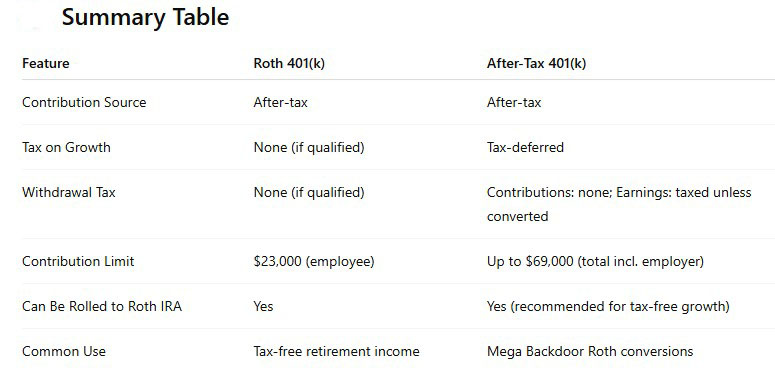
Let’s drill down just a bit on the key differences using this this chart.

You probably spotted that “Mega Backdoor Roth conversion” thing in the chart.  Okay, here’s the deal.  First of all, not all employers allow this in their 401(k) plan.  If yours does, a Mega Backdoor Roth conversion works by converting your After-Tax 401(k) contributions to a Roth account, allowing you to stash away tens of thousands of extra dollars into tax-free Roth savings.  Here are the steps you’ll need to take for this rollover:  Max out your traditional/Roth 401(k) (that is, hit the regular contribution limit); add your After-Tax contributions (to go beyond the limit) and then convert to Roth (to ensure future growth is tax-free).
Also, it’s worth emphasizing how the withdrawal taxes work.   After-Tax 401(k) contributions do not receive the same treatment of growth in the account as a Roth 401(k) does.  Only the contributions to the After-Tax 401(k) are tax-free.  Unless your plan allows immediate conversion to a Roth 401(k), the After-Tax gains are taxable when withdrawn.

In summary, use a Roth 401(k) if:

  • You expect higher taxes in retirement.
  • You’re younger and want decades of tax-free growth.
  • You want simplicity and qualified tax-free withdrawals.

And use an After-Tax 401(k) if:

  • You want to contribute beyond the 2025 annual $23,500 limit (plus an additional $7,500 for those 50 and older).
  • Your plan allows in-service withdrawals or conversions to Roth (enabling the Mega Backdoor Roth).
  • You have maxed out other tax-advantaged options.

You can see that under the right circumstances, an After-Tax 401(k) contribution can really help you grow your retirement account.  Some of the details can be a bit confusing, so If you’d like some help analyzing this for your situation, we’re available to talk things over in a no-charge, no-obligation initial meeting.  Please visit our website or give us a call at 970.419.8212 to set up an in-person or virtual meeting.

This article is for informational purposes only. This website does not provide tax or investment advice, nor is it an offer or solicitation of any kind to buy or sell any investment products.  Please consult your tax or investment advisor for specific advice.

Family Loans or Gifts

Whether you decide to help a family member (or a friend) with a loan or a gift, it can be tricky.  This month we’ll provide some information to help you decide whether to make a family loan, gift or to do nothing at all.

Sometimes, it’s just best to do nothing at all.  For example, you shouldn’t try to help if the money puts your finances in jeopardy.  One example is borrowing from your retirement fund.  If you decide not to help, you can soften the bad news by offering to help in some other way.  Maybe you can help them research loans from other sources.  Maybe you have the skills to help them with a remodel.  Maybe you can provide some childcare to decrease their expenses.  Maybe the family member can eat at your place for a while to decrease grocery expenses.  You get the idea.

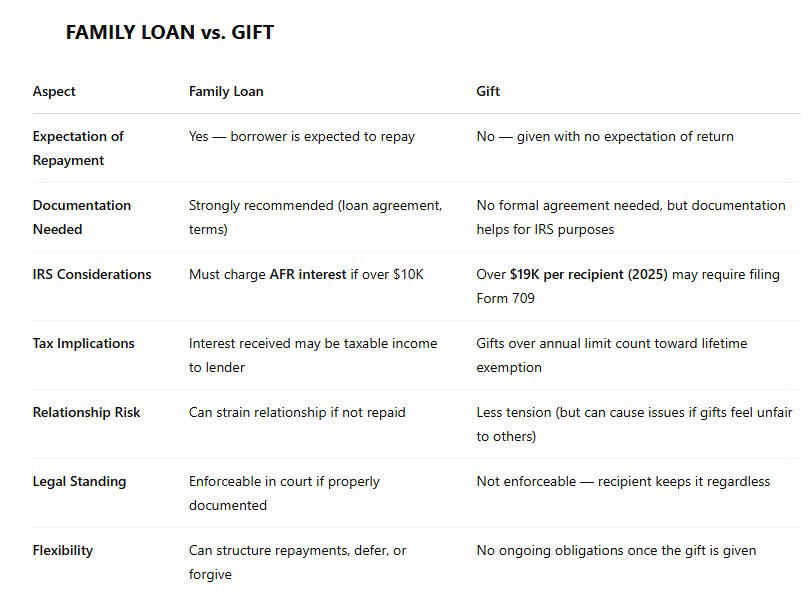
Now, if you think a loan or a gift is appropriate, here’s a handy chart to help you compare these options.

Once you decide which way to go, there are IRS considerations to keep in mind. Let’s start with the rules associated with a loan and then take a look at the rules for gifts.

IRS Rules for Family Loans

  • Charge the Minimum IRS Interest Rate (AFR)
    • The IRS requires you to charge at least the Applicable Federal Rate (AFR) for loans above $10,000.
    • These rates are published monthly and vary by loan term. Short-term loans are under 3 years. Mid-term rates are 3-9 years. Long-term rates are for periods beyond that. As an example, the annual short-term rate for May 2025 is 4.05%. (By the way, you don’t need to adjust the AFR during the life of the loan.)
    • If you don’t charge interest, or charge too little, the IRS may treat part of it as a taxable gift.
  • Watch Out for Gift Tax Rules
    • You can give up to $19,000 (as of 2025) per person per year tax-free.
    • Anything above that may count toward your lifetime gift tax exemption (currently over $13 million, but still needs to be reported).
  • Document the Loan Properly
    • To show it’s a real loan, not a gift:
      • Write a formal promissory note.
      • Include interest rate, payment schedule, due date.
      • Keep a record of all payments made.
    • If the IRS audits either party, you’ll have proof it’s legit.
  • If They Don’t Repay
    • If the borrower defaults, and you want to claim a bad debt deduction, the loan must:
      • Be a bona fide loan (properly documented).
      • Be completely worthless (no chance of repayment).
      • Be reported as a nonbusiness bad debt—which is deductible only as a short-term capital loss (up to $3,000 per year for individuals).
  • Keep Good Records
    • Even with family, treat it like a business deal.
    • Log all payments received.
    • Keep copies of checks, bank transfers, emails, or text confirmations.

IRS Rules for Family Gifts

  • Annual Gift Tax Exclusion
    • In 2025, you can give up to $19,000 per recipient per year tax-free, with no filing required. Married couples can combine exclusions and give $38,000 per person per year.
    • Example:
      • You give your niece $10,000 in 2025 → No problem.
      • You give her $25,000 → $19,000 is excluded; the extra $6,000 must be reported on a gift tax return (IRS Form 709), but no tax is due unless you exceed your lifetime limit.
  • Lifetime Gift Tax Exemption
    • As of 2025, the lifetime exemption is $13.99 million per person. (Note that it will drop to $7 million per person in 2026 unless new legislation is approved.)
    • If you gift more than the annual limit in a year, the excess counts against this lifetime exemption.
    • You don’t owe taxes until you’ve gifted more than $13.99 million total.
    • Example:
      • Over time, you gift $1 million over the annual limits → You’re fine, it just chips away at your $13.99 million exemption.
  • What Counts as a “Gift”
    • Cash, property or forgiveness of debt (like forgiving a family loan).
    • Selling something for less than fair market value.
    • Paying someone else’s bills (tuition, rent, etc.) without getting something in return.
  • Exceptions — What You Can Gift Unlimited Without Taxes
    • Tuition (paid directly to an educational institution).
    • Medical expenses (paid directly to the provider).
    • Gifts to a spouse (if U.S. citizen).
    • Gifts to political organizations.
  • Reporting Gifts — IRS Form 709
    • You must file Form 709 if:
      • You give more than $19,000 to any one person in a year.
      • You gift hard-to-value items (like art, real estate, etc.).
      • You split a gift with your spouse.
    • Note: Just filing doesn’t mean you owe tax; it just keeps track of your lifetime exemption usage.

You can see that it’s important to think through a potential family loan or gift. There are important IRS considerations as well.  If you’d like some help analyzing this for your family situation, we’re available to talk things over in a no-charge, no-obligation initial meeting.  Please visit our website or give us a call at 970.419.8212 to set up an in-person or virtual meeting.

This article is for informational purposes only. This website does not provide tax or investment advice, nor is it an offer or solicitation of any kind to buy or sell any investment products.  Please consult your tax or investment advisor for specific advice.

Financial Literacy Month

April is Financial Literacy Month.  Financial literacy is the ability to understand and manage personal finances effectively. It involves skills such as budgeting, saving, investing and making informed financial decisions. Strong financial literacy helps individuals achieve financial stability and long-term security.

While there are many aspects to financial literacy, many people think that the following are the core set:

  • Budgeting – Tracking income and expenses to manage spending and savings. Budgeting can really relieve much of your financial stress because you know where your money is going which makes it much easier to redeploy it if necessary.  Even without any historical data (which takes a bit to collect), there’s a decent rule of thumb to guide you.  It’s the 50/30/20 rule.  It merely suggests spending 50% of your after-tax income on life’s necessities, 30% on things that are more in the discretionary category and 20% on savings and debt reduction.
  • Saving & Emergency Funds – Setting aside money for future needs and unexpected expenses. I’ve written that “It’s not what you make – it’s what you keep.”   Savings drive the success of your emergency fund, retirement fund and other investments for future requirements. Your level of savings directly impacts your net worth and retirement success.
  • Debt Management – The management of outstanding debts such as loans, mortgages and credit card balances.  Some debt is necessary for most of us — such as when we buy a new home. However, debt should be minimized wherever possible.  Here’s an article I wrote that tells you why.
  • Investing – Allocating funds to various investment vehicles such as stocks, bonds, real estate and retirement accounts to grow wealth over time.
  • Credit & Credit Scores – Learning how credit works and how to maintain a good credit score. A numerical representation of an individual’s creditworthiness, which impacts borrowing ability and interest rates on loans. A score over 750 is a good initial goal.
  • Taxes – Understanding income taxes, deductions and tax-saving strategies. Naturally the goal here is to minimize taxes.  One good starting point is to understand credits and deductions in order to reduce what you owe.  You might want to check out one of my recent blogs that covers this information.
  • Retirement Planning – Preparing for the future with 401(k)s, IRAs and other retirement plans. These savings will be needed when you stop working.  While it’s never too late to start, it’s best to start while you’re young to let your investments grow over time.  My favorite vehicle for retirement savings is a Roth IRA.  A 401(k), especially if your employer provides matching funds, is also very important for long-term wealth building.  There are also individual Traditional IRAs as well as regular taxable investments.  We feel that it’s best to invest 15-20% of your net pay into this fund.  Setting up automatic withdrawals for this is a great way to accumulate what you need for a comfortable retirement.

You can undoubtedly see that financial literacy is really important for achieving many of your goals in life.  Whether your financial knowledge is pretty advanced or whether you’re just getting started, we’re available to review your particular situation in a no-charge, no-obligation initial meeting.  Please visit our website or give us a call at 970.419.8212 to set up an in-person or virtual meeting.

This article is for informational purposes only. This website does not provide tax or investment advice, nor is it an offer or solicitation of any kind to buy or sell any investment products.  Please consult your tax or investment advisor for specific advice.

Tax Filing 2024

The deadline for filing your 2024 taxes is just 6 weeks away – April 15, 2025. Most of us don’t look forward to this, but this month I’ll offer a few tips to help you get organized and hopefully reduce the pain.

First of all, you can easily extend this deadline to October 15, 2025 by sending in Form 4868. You’ll also need to submit the taxes owed for 2024 to avoid interest and penalties. People often wonder how to avoid these charges when filing late. Some people estimate their 2024 taxes and pay that amount. This can be time consuming, so happily the IRS has provided a way to make a payment based on your 2023 taxes. (This is called the Safe Harbor Rule.) Here’s how that works:

  • Pay at least 90% of your current year’s tax liability (e.g., for 2024 taxes, pay 90% of what you owe by April 15, 2025).
  • Pay 100% of your prior year’s tax liability (or 110% if your AGI was over $150,000 in 2023).

For example, if your 2023 tax owed was $10,000, then:

  • You must pay at least $10,000.
  • Or, $11,000 if your AGI > $150K.

That covers your federal liability, but what about state taxes? It’s actually pretty similar to the federal rules, but with one wrinkle. Here are the Safe Harbor Rules for Colorado. (Rules vary state by state.)

  • 90% of your current year’s tax liability: Pay at least 90% of the tax you owe for the current year.
  • 100% of your prior year’s tax liability: Pay an amount equal to 100% of the tax you owed in the previous year. This applies only if the previous year was a full 12-month tax year and you filed a Colorado tax return. (See the wrinkle? The 110% federal provision doesn’t apply to Colorado.)

Okay, one more thing. If you file quarterly estimates, you must make quarterly payments to the IRS and to your state by April 15. Here’s how to avoid penalties and interest. For federal taxes, pay:

  • 90% of your estimated 2024 total tax (divided into four equal payments).
  • 100% of your 2023 total tax (110% if AGI > $150,000) and split into four payments.

For example, if your 2023 federal tax owed was $20,000, then:

  • Pay 100% or $5,000 per quarter ($20,000 ÷ 4).
  • If your AGI > $150K, pay $5,500 per quarter ($22,000 ÷ 4).

For Colorado estimated payments, suppose your 2023 state tax owed was $10,000, then:

  • Pay 100% or $2,500 per quarter ($10,000 ÷ 4).

Okay, now let’s develop a sort of checklist to follow whenever you file (April 15 or October 15).

1. Gather your documents early

  • Income forms: W-2s, 1099s (freelance, investments, etc.), K-1s (if applicable).

Note: See last month’s blog to understand the different between deductions and credits.

  • Deduction records: Mortgage interest (Form 1098), student loan interest, charitable donations, medical expenses.
  • Tax credits: Child Tax Credit, Earned Income Tax Credit (EITC), education credits (Form 1098-T).

2. Watch for tax law changes

  • Some pandemic-era tax breaks have expired, so refunds may be smaller than in previous years.
  • If you have student loans, the pause on interest and payments ended in 2023, so interest payments might be deductible.

3. Maximize deductions & credits

  • Standard deduction (2024):
    • Single: $14,600
    • Married Filing Jointly: $29,200
    • Head of Household: $21,900
  • Consider itemizing if deductions (medical expenses, mortgage interest, state/local taxes) exceed the standard deduction.

4. Contribute to tax-advantaged accounts

  • You can still contribute to an IRA, HAS or 401(k) accounts for 2024 until April 15, 2025, to lower your taxable income.
  • 401(k) contributions for 2024 max out at $23,000 ($30,500 if 50+).

5. Avoid common mistakes

  • Double-check Social Security numbers, bank account details (for direct deposit) and filing status.
  • Report all income, including side gigs and cryptocurrency transactions.

6. File electronically & choose direct deposit

  • E-filing is faster, more secure and reduces errors compared to paper filing.
  • The IRS typically processes refunds within 21 days for electronic returns with direct deposit.

7. Beware of scams & identity theft

  • The IRS will NEVER call, text or email demanding payment.
  • Consider getting an Identity Protection PIN (IP PIN) for extra security.

8. Use free filing options (if eligible)

  • The IRS Free File program offers free tax software for those earning $79,000 or less.
  • Volunteer Income Tax Assistance (VITA) is available for lower-income taxpayers.

9. Hire a professional (if needed)

  • If you have complex taxes (e.g., business income, major investments or rental properties), consider a CPA or enrolled agent.
  • Or, consider using a professional to just reduce your stress and free up some valuable time.
  • Ensure your tax preparer has a PTIN (Preparer Tax Identification Number).

Whew, who said filing taxes was easy! But, we’re here to help. So, if you’d like to further talk about taxes, or any other financial matters, we can discuss things in a no-charge, no-obligation initial meeting.  Please visit our website or give us a call at 970.419.8212 to set up an in-person or virtual meeting.

This article is for informational purposes only. This website does not provide tax or investment advice, nor is it an offer or solicitation of any kind to buy or sell any investment products.  Please consult your tax or investment advisor for specific advice.