

This month we’ll take a look at the benefits of consolidating retirement accounts. The key idea is that consolidation should simplify your financial life without accidentally giving up a tax advantage or valuable retirement-plan feature. Here are a few of the common reasons for consolidation.
- Simplify your finances, track your investments more easily
- Easier diversification, asset allocation
- Less work at tax time
- Lower administrative fees
- Easier calculations for Required Minimum Distributions (RMDs)
If these reasons convince you to consider consolidation, here is a summary of what to think about by account type.
Traditional IRA → Traditional IRA. This is often the simplest consolidation. If you have multiple IRAs, you can generally transfer them into one traditional IRA. You’ll want to check the following:
- Fees and investments. Will the new provider give you comparable or better investment choices at a reasonable cost?
- Nondeductible contributions. Determine whether you have any after-tax basis. Keep your Form 8606 records. (Form 8606 is the tax document that is used to report nondeductible (after-tax) contributions to a traditional IRA, track IRA basis and report distributions or conversions.)
- Roth conversion plans. This is especially important. If you expect to do Roth conversions, having traditional, SEP, and SIMPLE IRA balances can affect the taxable portion of a conversion under the pro-rata rule. (The pro-rata rule states that if your account contains both pretax and after-tax amounts, any distribution will generally include a pro-rata share of both. For example, suppose your account balance is $100,000 — consisting of $80,000 in pretax amounts and $20,000 in after-tax amounts. You request a distribution of $50,000. Your distribution consists of $40,000 pretax and $10,000 after-tax.)
- Consolidating traditional IRAs can make RMD administration easier.
Roth IRA → Roth IRA. As with the traditional IRA, this is also generally straightforward. In this case you’ll want to check the following:
- Investment choices and fees. As with traditional IRAs, compare the actual investment expenses and account/advisory fees.
- Contribution and conversion history. Keep good records of contributions and conversions. Roth IRA withdrawal rules have specific ordering rules and the age/date of conversions can matter.
- Roth IRAs can be particularly useful for estate planning because qualified withdrawals generally aren’t taxable to the beneficiary, although beneficiaries generally have distribution requirements.
401(k) → 401(k). This is worth some research because an old 401(k) isn’t automatically inferior to your current plan. You’ll want to look into the following:
- Investment expenses
- Administrative fees
- Investment choices
- Roth 401(k) availability
- Stable-value funds
- Loan provisions
- Withdrawal options
- Whether the plan accepts rollovers
- RMD rules
- Employer stock
401(k) → Traditional IRA. This rollover strategy is one of the most common consolidation strategies. However, if you anticipate Roth conversions, moving pre-tax 401(k) money into an IRA can make the pro-rata rule more complicated.
Roth 401(k) → Roth IRA. If you have a Roth 401(k), you may be able to roll it into a Roth IRA. This could give you more investment choices, no lifetime RMDs for the Roth IRA owner and the ability to consolidate with an existing Roth IRA. (Be sure to preserve records concerning the Roth 401(k)’s contribution and conversion history, because Roth distribution rules can differ between employer plans and Roth IRAs.)
Consolidating retirement accounts can make a lot of sense, but you can see that there are some important things to think through. If you’d like to discuss the best way to do this in your situation, or discuss any other financial matters, we’d be happy to get together in a no-charge, no-obligation initial meeting. Please visit our website or give us a call at 970.419.8212 to set up an in-person or virtual meeting.
This article is for informational purposes only. This website does not provide tax or investment advice, nor is it an offer or solicitation of any kind to buy or sell any investment products. Please consult your tax or investment advisor for specific advice.
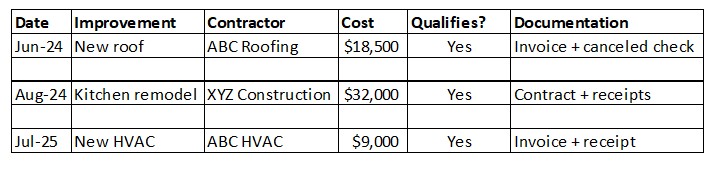 It’s really best to track these improvements as they occur rather than trying to do it when you sell your home. In addition to how busy people often are when they sell their home, the problem with waiting until the sale is that receipts may be missing, contractors may be gone and it can be difficult to remember exactly what was done and when.
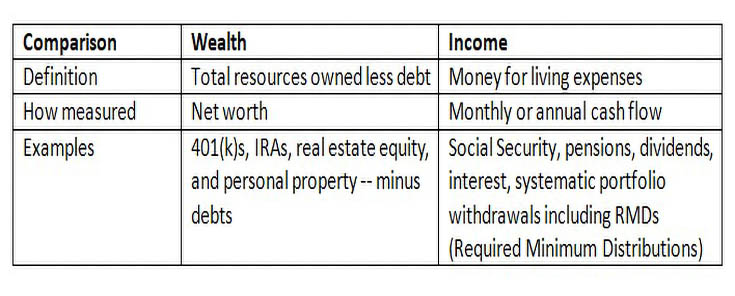 At first blush, it may seem logical that wealthy people have high incomes – and many do. But, high income does not automatically translate into wealth. One classic example of this is a doctor who earned a very high salary, but didn’t save much because of his student debt, extravagant life style and other factors. Conversely, an office worker with a modest salary might have socked away 15% of her salary each year over her entire career. At retirement, she’d have high wealth even though her income had been low during her working years.