

This month let’s take a look at how to track increases on your home’s basis in order to reduce any taxes owed when the home is sold. Tax rules that govern the sale of a home can range from simple to more complicated. For many of us, it should be fairly simple and that’s what we’ll focus on in this article.
Here are the key concepts:
- We’re talking about your principal residence (and not a rental or investment property).
- You’ve lived in your home at least 2 years out of the last five (and that time need not be consecutive).
- You haven’t sold another principal residence in the last two years.
Okay, if all that’s true for you, when you sell your home the capital gain (how much more the buyer paid less whatever you bought the home for — less any basis adjustments) is tax free if you’re a couple filing jointly and the capital gain is $500,000 or less — $250,000 if you file an individual return. (By the way, various proposals are being discussed in congress right now that could eliminate taxes on home sales even further.)
If you exceed these limits, you’ll owe some taxes, but they can be reduced by tracking increases in your basis. (Basis is what you paid for your home plus the capital improvements you made.) A key distinction here is capital improvements versus repairs/maintenance. Here’s a list of typical capital improvements.
- Home additions
- Kitchen/bathroom remodels
- New roof
- New HVAC
- New windows
- Major electrical or plumbing improvements
- New driveway
- Deck or patio
- Swimming pool
- Certain landscaping
- Certain legal/closing costs when you purchased the property
And here’s a list of typical maintenance items (which don’t change your home’s basis).
- Painting
- Carpet cleaning
- Routine lawn care
- Minor plumbing repairs
- Fixing a broken appliance
- Routine maintenance
- Replacing something with essentially the same item as ordinary maintenance
There are also things that can actually decrease basis. Examples include:
- Insurance claim payments for storm damage and other losses
- Payments for installing energy-efficient items like solar panels
You’ll need to track and document qualifying improvements from the time they occur until the home is sold. A spreadsheet is a great way to do this. You’ll also need to retain receipts that document these expenses. Here’s a typical spreadsheet to help you visualize this.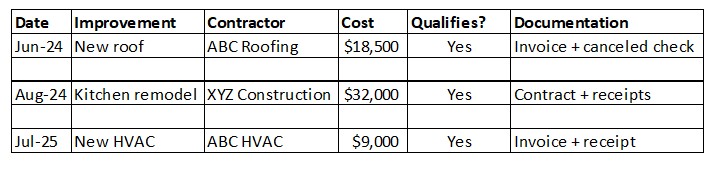 It’s really best to track these improvements as they occur rather than trying to do it when you sell your home. In addition to how busy people often are when they sell their home, the problem with waiting until the sale is that receipts may be missing, contractors may be gone and it can be difficult to remember exactly what was done and when.
Hopefully this helps you understand how tracking home improvements can help you reduce your taxes (if you exceed the $250,000/$500,000 exemption). Some of the complications come into the picture if this isn’t your primary residence, if it’s an investment property, if you’re in the military, if you’re recently divorced and so on. If you’d like to discuss reducing the taxes on the sale of your home, or any other financial matters, we’d be happy to get together in a no-charge, no-obligation initial meeting. Please visit our website or give us a call at 970.419.8212 to set up an in-person or virtual meeting.
This article is for informational purposes only. This website does not provide tax or investment advice, nor is it an offer or solicitation of any kind to buy or sell any investment products. Please consult your tax or investment advisor for specific advice.