
Who wouldn’t want lower their taxes? Well, if you meet certain criteria (described in a sec), it’s possible to do just that using a Qualified Charitable Distribution. A QCD is a direct transfer of money from an eligible IRA to a qualified charity. It allows eligible individuals to support charitable organizations while reducing their taxable income. QCDs are particularly useful for retirees who have traditional IRAs and are required to take required minimum distributions (RMDs) and don’t need the cash for other expenses. This makes even more sense if you like to support charities in the first place.
Okay, so are you eligible to use a QCD? Here are the 2026 rules for using a QCD:
- Age requirement: You must be at least 70½ when the distribution is made. (Note that you do not need to be old enough for RMDs to be required.)
- Annual limit: Up to $111,000 per person for 2026, subject to applicable rules.
- Eligible accounts: Generally traditional IRAs and certain inherited IRAs. Employer retirement plans, such as 401(k)s, generally do not qualify directly.
- Eligible charities: Most qualifying public charities are eligible, but donor-advised funds and private foundations generally do not.
- Direct transfer: The money must go directly from the IRA custodian to the charity. (A QCD is not the same as taking an IRA distribution and then donating the money. The transfer must go directly to the charity to receive QCD treatment.)
- Tax deduction: You generally cannot also claim a charitable deduction for the amount excluded from income.
Okay, so you can contribute your RMD (or some portion of it) to a qualified charity and pay no taxes on it (up to the $111,000 annual limit). You may wonder why you can’t just take your RMD directly to yourself and then write a check to the charities you want to support. That’s because a QCD reduces taxable income directly, while a regular charitable donation generally reduces taxable income only if you qualify to claim an itemized deduction. Here’s a simple comparison to help you understand the details of this.
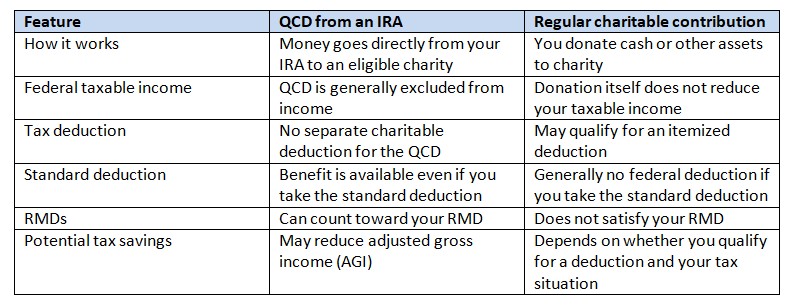
Hopefully you can see how useful a QCD can be if you are don’t need your RMD for other purposes. There are some details that matter. Some of the biggest QCD pitfalls are getting the transfer process wrong, donating to an ineligible organization, missing the year-end deadline or reporting the gift incorrectly on your tax return. Any of these can undermine the tax benefit. To avoid these problems, or to discuss any other financial matters, we’d be happy to get together in a no-charge, no-obligation initial meeting. Please visit our website or give us a call at 970.419.8212 to set up an in-person or virtual meeting.
This article is for informational purposes only. This website does not provide tax or investment advice, nor is it an offer or solicitation of any kind to buy or sell any investment products. Please consult your tax or investment advisor for specific advice.